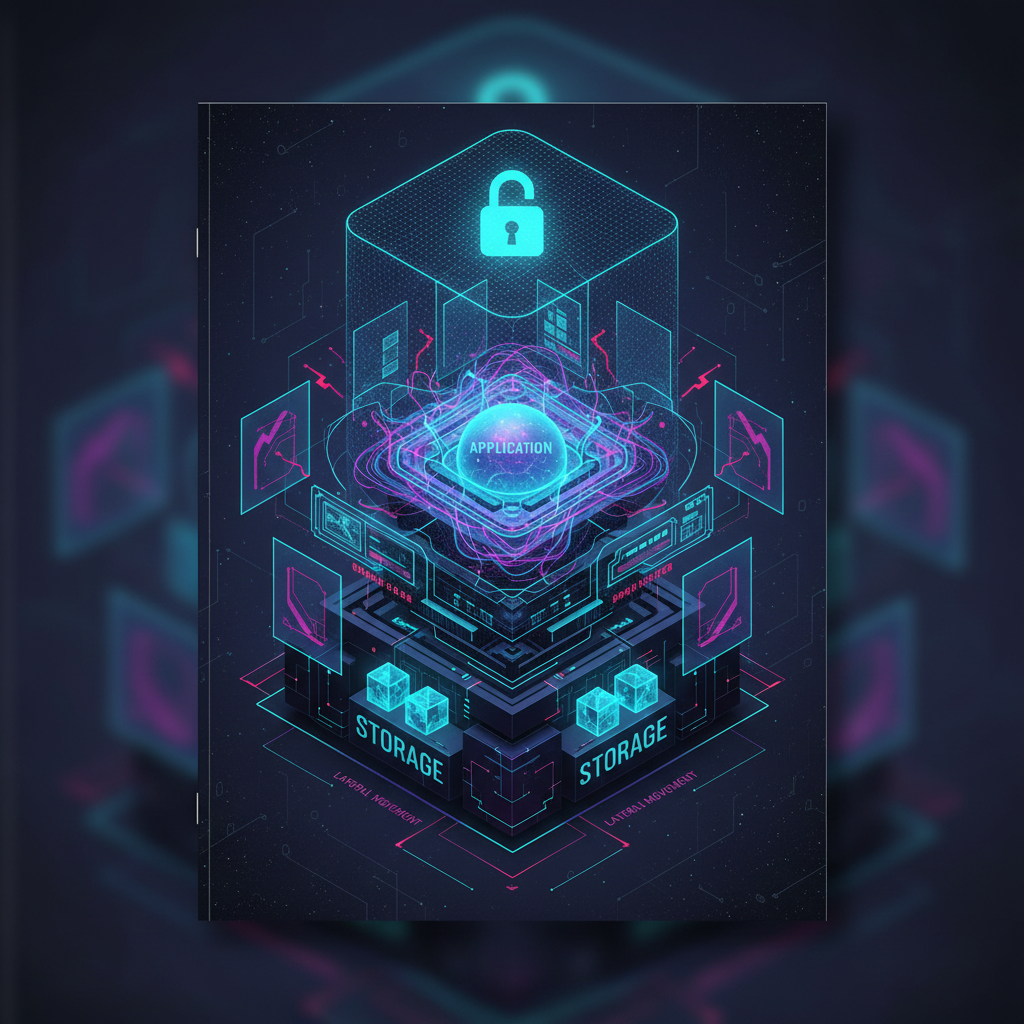
Securing the Full Stack: Why Application, Storage, and Network Controls Are Non-Negotiable
November 27, 2026
Prevent lateral movement and data loss by hardening configuration baselines, storage immutability, and network segmentation across your entire tech stack.
Implementing comprehensive application, storage, and network controls is essential for neutralizing cyber threats before they traverse your infrastructure. Most enterprise intrusions do not stem from exotic, zero-day vulnerabilities; they succeed because an attacker capitalized on default settings, flat internal networks, or unauthenticated storage buckets. By establishing rigorous, defense-in-depth controls across every technological layer, organizations transform brittle IT environments into resilient digital operational architectures.
Without cohesive hardening, an initial foothold on a single user workstation can rapidly escalate into enterprise-wide compromise. Robust policy enforcement prevents lateral movement, chokes unauthorized data exfiltration, and ensures critical business assets remain inaccessible to unauthorized entities.
The Architectural Flaws Attackers Exploit Most
In modern hybrid enterprise environments, complexity is the primary enemy of security. When IT teams rapidly spin up cloud services, provision storage volumes, or deploy internal software without unified configuration baselines, security gaps emerge naturally.
These vulnerabilities typically manifest across three distinct domains:
- Application Vulnerabilities and Configuration Drift: Web applications and internal portals often run with unnecessary privileges, exposed debugging interfaces, or legacy protocols enabled by default.
- Permissive Storage Configurations: Cloud object storage, file shares, and local Network Attached Storage (NAS) frequently lack granular Access Control Lists (ACLs), immutable backup protections, or default encryption at rest.
- Flat and Permissive Networks: Many enterprise networks still lack meaningful internal segmentation. Once an intruder breaches perimeter defenses, no internal boundaries prevent them from pivoting directly to domain controllers or core databases.
Defensive maturity is not measured by the number of security tools deployed, but by how effectively technical controls eliminate unearned trust across systems.
Addressing these foundational vulnerabilities requires shifting away from reactionary patching and moving toward systematic environmental hardening. Conducting regular vulnerability assessments helps identify these structural gaps before malicious actors discover them.
Core Pillars of Full-Stack Control Hardening
Building an impenetrable operational environment requires establishing rigorous technical constraints across the entire infrastructure footprint. Rather than managing each layer as an isolated silo, organizations must unify their defensive posture across applications, data storage, and network traffic.
+--------------------------------------------------------------+
|                     APPLICATION CONTROLS                     |
|    Input Validation • Code Signing • Least-Privilege API     |
+--------------------------------------------------------------+
                               |
                               v
+--------------------------------------------------------------+
|                       STORAGE CONTROLS                       |
|   Immutability • Encryption at Rest • Explicit Zero-Trust    |
+--------------------------------------------------------------+
                               |
                               v
+--------------------------------------------------------------+
|                       NETWORK CONTROLS                       |
| Microsegmentation • Egress Filtering • Lateral Route Blocks  |
+--------------------------------------------------------------+
Application Security Controls
Applications serve as the interface to critical business logic and proprietary data. Hardening controls at this tier begins with enforcing strict configuration baselines across all production services, disabling unused modules, and stripping out default administrative credentials.
Modern application governance mandates tight runtime controls. By utilizing software execution policies, application allowlisting, and containerized runtime protections, organizations restrict processes from executing arbitrary code or spawning unauthorized shells.
Storage Isolation and Immutability
Data repositories represent the ultimate target for extortion campaigns and corporate espionage. Storage controls must go beyond standard folder-level permissions to enforce verifiable zero-trust access policies.
This includes enabling continuous encryption for data at rest and in transit, revoking public read capabilities by policy, and implementing hardware-enforced immutability for enterprise backups. When ransomware operators attempt to encrypt or delete secondary recovery tiers, immutability ensures your recovery path remains intact without ransom negotiations. Pairing these protections with privileged access management guarantees that administrative credentials cannot be unilaterally hijacked to purge records.
Network Microsegmentation and Flow Enforcement
Perimeter firewalls alone cannot protect an organization from modern, identity-driven lateral attacks. Internal network controls divide the environment into isolated, distinct trust zones through microsegmentation.
By restricting traffic between servers using zero-trust network policies, workstations cannot communicate with each other over administrative ports like SMB or RPC. Egress filtering strictly monitors and limits outbound connections, preventing compromised assets from reaching external command-and-control servers or exfiltrating mass data troves.
Who Needs Technical Stack Hardening?
Any business managing proprietary intellectual property, customer records, or high-availability operational technology needs structured stack controls. However, specific operational landscapes face amplified exposure:
- Regulated Industries: Healthcare, financial services, and defense suppliers must prove adherence to stringent isolation and encryption mandates under frameworks like HIPAA, PCI DSS, and CMMC. Validating these safeguards against standardized benchmarks through structured CIS and NIST framework assessments ensures verifiable audit readiness.
- Hybrid Cloud Enterprises: Organizations operating mixed footprints across on-premises data centers and multi-cloud providers require uniform security baselines that prevent configuration drift.
- Fast-Scaling Technology Companies: Rapid software releases often outpace manual infrastructure audits, making programmatic policy enforcement critical to keeping development and production environments safe.
Real-World Scenario: Stopping Lateral Movement
Consider a mid-sized healthcare organization that experienced a targeted phishing intrusion. An employee in billing opened a weaponized macro, executing malware that compromised their local workstation.
In a conventional, flat network environment, the adversary would harvest local credentials, scan the subnet, and compromise internal file repositories and patient scheduling databases within hours.
Because the organization implemented strict application, storage, and network controls, the breach collapsed at the initial machine:
- Application controls blocked unsigned scripting engines from executing unauthorized secondary payloads.
- Network microsegmentation prevented the infected workstation from scanning administrative subnets or communicating laterally with neighboring administrative endpoints.
- Storage policies restricted file shares to explicit, authenticated device identities, rejecting connection attempts originating from untrusted processes.
The intrusion was contained to a single endpoint, allowing security teams to remediate the isolated asset without declaring an enterprise-wide disaster or reporting an unauthorized data breach.
Common Misconceptions About Technical Controls
Deploying comprehensive controls across applications, storage, and network devices often encounters internal organizational resistance. IT leadership frequently confronts several pervasive myths:
Misconception 1: Hardening Disrupts End-User Productivity
A frequent objection is that strict network policies and application allowlisting grind daily operations to a halt. In practice, modern policy enforcement leverages behavioral telemetry and automated allowlists that run transparently in the background. Performance issues typically stem from ad-hoc, uncoordinated rule changes rather than standardized, engineered baselines.
Misconception 2: Endpoint Detection Renders Controls Redundant
Many teams assume that deploying modern detection platforms eliminates the need for granular baseline configurations. While continuous endpoint monitoring is critical, detection systems rely on recognizing malicious behaviors or anomalous signatures. Hardened controls eliminate the baseline attack surface entirely, ensuring that entire categories of lateral movement are physically impossible, regardless of whether a detection alert fires.
How Technical Controls Complement Incident Response and Recovery
Incident response succeeds or fails based on containment speed. When an adversary penetrates an unsegmented, permissive network, incident response teams face an uphill battle mapping the blast radius across hundreds of untracked servers.
Strict infrastructure controls transform incident response outcomes. Segmentation acts as a system of fire doors inside a facility: even if an adversary gains a foothold, they remain trapped inside a confined security zone. This containment preserves clean system recovery paths, isolates forensic evidence, and dramatically reduces mean time to remediation (MTTR).
Furthermore, immutable storage controls ensure that clean, authenticated recovery points remain untampered. When incident response specialists remediate a compromised segment, systems can be restored from hardened backups rapidly without risk of reinfection.
How Lyra Helps
Securing modern operational infrastructure demands continuous engineering discipline across every layer of your technology ecosystem. Lyra delivers end-to-end application, storage, and network controls that replace configuration guesswork with hardened, production-ready baselines tailored to your unique operational workflow.
Our team analyzes your current architecture, designs least-privilege network segmentation, locks down cloud and local storage repositories, and implements application governance that halts adversaries in their tracks. By embedding these controls directly into your operational fabric, we protect your organization against lateral movement and systemic outages.
Take the first step toward building an inherently resilient infrastructure. Contact Lyra today to consult with our enterprise cybersecurity and infrastructure engineering team.